
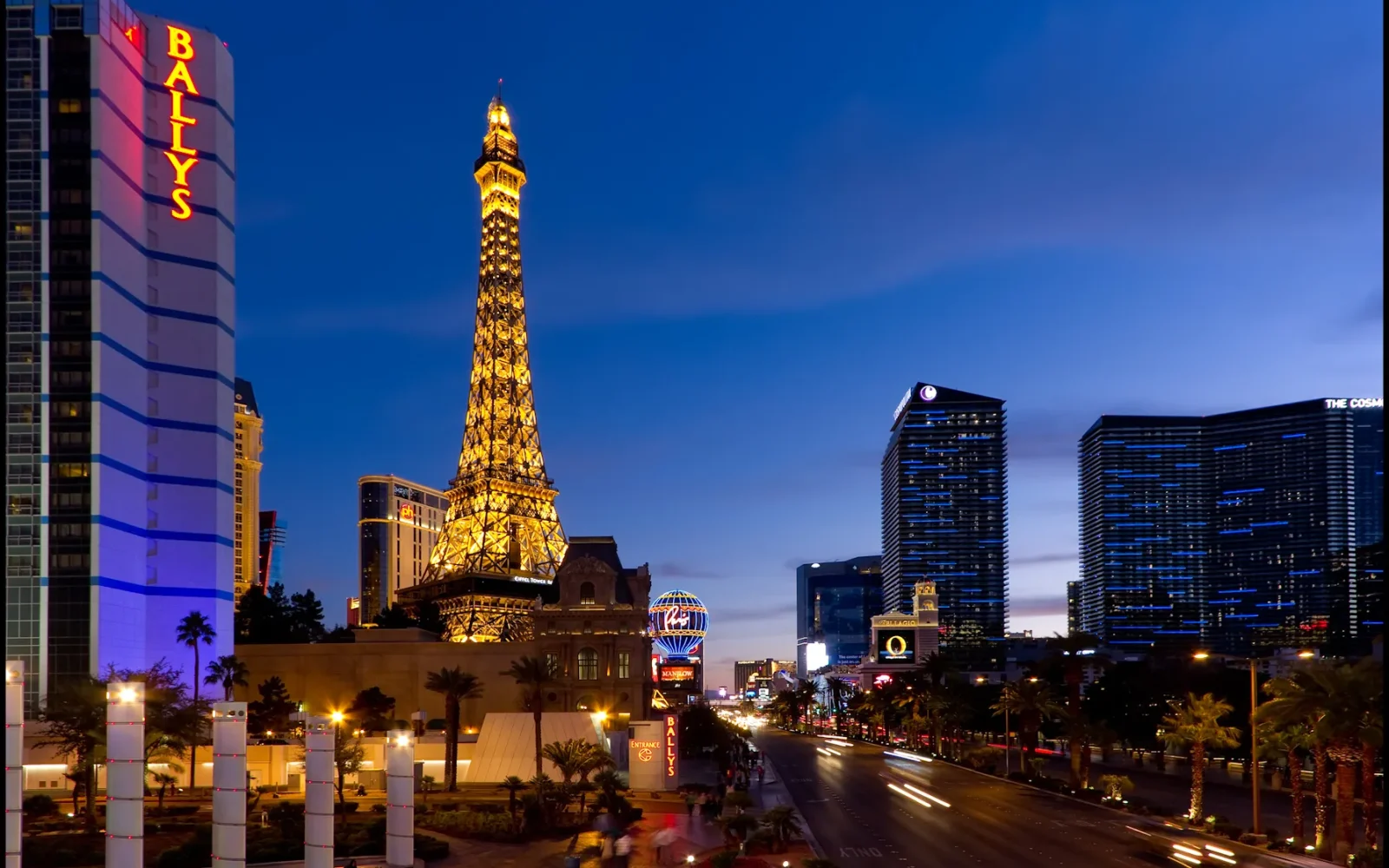
One long day in Las Vegas can reveal far more than a single boulevard, but only if the day has a clear shape. The tempting approach is to collect as many famous names as possible. That usually creates a blur of indoor corridors, vehicle transfers, and rushed meals. A better plan uses contrast. See the resort corridor when its public spaces are calm enough to notice, spend part of the day at street level in the Arts District and Downtown, then return to the large-scale city after dark.
This guide is a framework, not a minute-by-minute promise. Venue access, exhibition dates, road conditions, reservation rules, and public transit can change. Choose one ticketed anchor, confirm its details with the responsible operator, and let the rest of the day remain flexible. The route works without gambling and does not require a particular show, restaurant, or paid attraction.
It also starts with an important geographic distinction. The famous stretch commonly called the Strip is largely outside the incorporated City of Las Vegas, while Downtown is within the city itself. They are connected parts of the same visitor experience, but they look, move, and operate differently. Treating them as separate chapters makes the day easier to understand.
The idea: one city, three changes of scale
Build the day around three visual scales. The first is monumental: resort facades, vast interiors, landscaped approaches, performance architecture, and a boulevard designed to announce itself. The second is human: storefronts, studios, galleries, coffee counters, restaurant tables, and the working details of signmaking and hospitality. The third is metropolitan: Downtown blocks, civic history, changing streets, and a night skyline set inside the Las Vegas Valley.
You do not need equal time in every chapter. If food is the priority, lengthen the neighborhood portion. If a performance is the anchor, protect the arrival window and simplify everything before it. If architecture and design lead the trip, trade a second resort stop for Downtown museums or a slow Main Street walk.
Planning principle: choose one major spectacle, one street-level district, and one unhurried meal. Everything else is a useful extra, not a test of how much ground you can cover.
Before you leave: make four decisions
Choose the evening anchor
A performance, exhibition, dinner reservation, or gathering point can organize the second half of the day. Confirm the current entry rules, location, travel time, and accessibility information directly. Resort and venue names may be similar, and a pickup point may not be at the entrance you expect. Save the exact address and any official instructions offline.
Pick one daytime interior
Many resort complexes are destinations in themselves. Select one interior you genuinely want to see rather than wandering through several simply because they are famous. Architecture, a garden, a public art installation, or a quiet meal can provide a clear reason to enter. This keeps the first chapter focused and leaves energy for the rest of the city.
Choose a neighborhood meal area
The Arts District and Downtown fit the route with the least backtracking. The Spring Mountain Road corridor west of the Strip, commonly known as Chinatown, offers another strong food-focused option, but it adds a separate east-west transition. Decide whether the meal is a central experience or a convenient pause. If it is central, build the route around it rather than squeezing it between unrelated stops.
Set a walking limit
Map distance does not tell the whole story in Las Vegas. Large buildings, indirect pedestrian crossings, indoor routes, security queues, heat, and crowds can turn a short-looking connection into a meaningful walk. Decide how long you are comfortable walking at one time. Use a vehicle transition before fatigue makes every later choice harder.
Still comparing Food Tours?
Ask for tour ideas, hotel suggestions, or a simple trip plan that combines both.
Trip Helper
A flexible route at a glance
| Day phase | Area | Primary focus | What to protect |
|---|---|---|---|
| Quiet start | One Strip cluster | Scale, architecture, and orientation | A direct route and weather comfort |
| Street level | Arts District | Adaptive reuse, studios, shops, and local detail | Time to walk without rushing |
| Midday pause | Arts District, Downtown, or Chinatown | One purposeful meal | Reservation or current business details |
| City chapter | Downtown | History, signs, public spaces, and museums | One clear cultural anchor |
| After dark | Downtown or the Strip | Performance, light, and evening energy | A simple return and an unhurried finish |
The phases matter more than a specific clock. Seasonal heat may favor indoor time during the middle of the day. A museum reservation may reverse the Downtown and Arts District chapters. An evening event may make a Downtown finish more sensible than a return to the Strip. Preserve the sequence of scale even when the order changes.
Phase one: notice the resort corridor before it gets loud
Begin in one compact portion of Las Vegas Boulevard. Do not attempt the entire Strip on foot. Choose a cluster around your accommodation or a building you want to study, then identify an end point before you start. The goal is orientation, not completion.
Outside, look past themed references and notice the logistics of scale. Porte-cocheres separate vehicles from pedestrians. Bridges redirect foot traffic above major intersections. Facades create a recognizable silhouette from a moving car, while entrances often unfold through planted edges, water features, retail passages, and gaming floors. The building that appears next door may still require a long internal route.
Inside, slow down at transitions. Ceiling height, carpet, sound, lighting, scent, and signage tell visitors when they have moved from arrival to casino, shopping, dining, theater, or guest areas. You can appreciate this choreography without spending money. Respect closed spaces, avoid photographing people in private moments, and follow any posted restrictions.
If you want a broad view, use a legal public viewpoint or a venue you already plan to visit. Avoid building the route around an unverified rooftop or private terrace. The mountains around the basin are easiest to understand when the air is clear and the viewing direction is known. That geographic frame helps distinguish Las Vegas from a generic entertainment set.
How to keep this chapter manageable
- Choose one side of the boulevard for most of the walk.
- Cross only at designated pedestrian routes and obey closures.
- Enter one resort complex with a purpose.
- Save a second large interior for another day.
- Leave before your walking limit is exhausted.
The last point is important. The Arts District and Downtown become more rewarding when you arrive curious rather than tired. A deliberate vehicle transition also makes the change from monument to storefront feel immediate.
Phase two: read the Arts District at street level
The Las Vegas Arts District, often called 18b, sits between the resort corridor and Downtown. Its character comes from working streets rather than a sealed attraction. Low-rise commercial buildings, adapted warehouses, studios, vintage shops, galleries, restaurants, bars, murals, and small performance spaces create a different visual rhythm from the Strip.
Start with Main Street and use Commerce Street and connecting blocks according to comfort, weather, and current conditions. Look for the way older buildings have been reused. A broad vehicle opening may now frame a shop. Painted masonry may sit beside polished new construction. Signs are often closer to eye level, and window displays carry more of the visual work.
This is a neighborhood and workplace, not an outdoor set. Keep doorways and sidewalks clear. Ask before making a close portrait. Murals are artworks with creators, not anonymous Las Vegas texture. If a work catches your attention, look for a credit and learn who made it rather than cropping it into a decorative background.
Business turnover is part of the district, so a static list ages quickly. Instead of chasing a long roster, choose one or two categories that suit you: contemporary art, vintage furniture, books, local design, coffee, or a meal. Check the business’s own current information before making a special trip. Closed doors are not an invitation to improvise access.
A useful observation exercise
Compare three kinds of lettering as you walk: an older painted sign, a fabricated channel-letter sign, and a temporary poster or window message. Notice width, shadow, materials, attachment, and the distance from which each must work. Las Vegas sign culture becomes more interesting when it is understood as design and labor, not merely neon nostalgia.
When the weather is demanding, shorten the outdoor loop and use one indoor stop as a reset. Shade can be limited, and dry air may disguise how quickly you are losing water. A good route has permission to become smaller.
Phase three: make the meal an actual destination
Food is one of the strongest reasons to leave a single resort cluster, but an effective plan does not treat every neighborhood as interchangeable. Decide whether you want to remain in the Arts District, continue into Downtown, or make a separate trip west of the Strip to the Spring Mountain Road corridor.
Staying in the Arts District preserves time and keeps the day walkable in sections. Continuing Downtown makes sense if your afternoon anchor is already there. Choosing Chinatown can open a dense range of Asian and globally influenced restaurants, bakeries, dessert shops, markets, and late-day businesses, but the corridor is spread across commercial centers. Walking between distant stops may be uncomfortable or impractical. Choose the restaurant first, then plan the transport.
Avoid describing Las Vegas dining only through celebrity names or lavish rooms. Large resort restaurants are part of the destination, but so are family-run businesses, specialist cooks, bakers, bartenders, market teams, and servers across the valley. Read menus and policies from the business’s own source. Ask about dietary needs rather than assuming. A reservation platform, map listing, or social post can be out of date.
For a long day, the best meal is not necessarily the longest. It should offer a real pause, enough water, and a clear transition to what follows. If the evening includes a formal ticketed event, leave more margin than a navigation estimate suggests. Parking, pickup zones, venue entry, and large interiors all add time.
Phase four: choose one Downtown story
Downtown Las Vegas can support several different visits. Fremont Street supplies concentrated signage, casinos, pedestrian activity, and a strong after-dark identity. Main Street connects toward the Arts District and preserves a more linear storefront rhythm. Civic and cultural sites tell stories about settlement, organized crime, entertainment, water, natural history, and the built city. Trying to cover all of them in one afternoon recreates the checklist problem.
Choose one anchor with a question behind it. If you are interested in how Las Vegas advertises itself, a sign-focused museum or careful walk among older facades may lead. If you want civic history, select an institution whose collection directly addresses it. If you prefer contemporary urban change, focus on the blocks between established landmarks rather than treating each landmark as an isolated photo stop.
The Neon Museum is north of the core Downtown blocks and should be treated as a planned visit, not an accidental add-on. Its collection and the preserved La Concha lobby help explain sign design and Las Vegas architecture, but access details and ticket arrangements must be checked directly. Springs Preserve, west of Downtown, offers a different account rooted in the valley’s springs, environment, and history. It also deserves its own planned block rather than a rushed detour.
On Fremont Street, notice the coexistence of historic facades, newer digital surfaces, street performance, security, souvenir retail, and ordinary circulation. Keep valuables secure and remain aware of your group without turning public space into a story of fear. Ask permission before focusing a camera on a performer or vendor, and follow posted rules.
What Downtown adds to the day
The Strip demonstrates how private complexes orchestrate movement at enormous scale. Downtown lets you see shorter blocks, multiple property edges, older structures, civic space, and a more visible layering of change. Neither chapter cancels the other. Together they explain why Las Vegas can feel like several urban systems operating in one valley.
Phase five: let after dark be specific
Las Vegas at night is visually dense, so give the evening one center of gravity. It might be a stage performance, a carefully chosen dinner, a Downtown walk, a view across the boulevard, or time with friends. The experience becomes stronger when you are not repeatedly checking how to reach the next attraction.
If you return to the Strip, choose the vehicle drop-off or transit stop that best matches the actual venue entrance. Do not assume two venues in the same resort share the same path. Follow official wayfinding and ask staff when the route is unclear. If you remain Downtown, define a meeting point that everyone can recognize if the group separates.
Photography needs restraint after dark. High dynamic range processing can turn every surface into a synthetic glow and erase the dark sky that gives signs their presence. Expose for the main subject, include a human-scale reference when appropriate, and avoid blocking circulation for a symmetrical shot. Do not use a flash on performers or strangers without permission.
End with one quiet observation. A side street after a busy block, a final view toward the valley edge, a detail of metalwork, or the reset of a dining room can say more about Las Vegas than another collection of logos. The city is compelling partly because changeover never fully stops.
How to move between the chapters
Walking is best within a chosen cluster, not as the default connection between every area. Taxis, rideshare services, public transit, private vehicles, and organized transport may all be useful depending on the group. Service areas, routes, fares, pickup points, and accessibility can change, so consult current official or provider information.
For a hired ride, confirm the vehicle and driver information in the app or at the designated stand. Resort pickup zones can be separated from the main pedestrian entrance. For public transit, verify the route in both directions and save the stop location. For a private vehicle, understand whether parking is controlled by a resort, a public facility, a street regulation, or a private lot.
Avoid changing transport modes too often. One morning walk, one transfer to the Arts District or Downtown, and one evening transfer usually creates a more legible day than a chain of short rides. Travelers using mobility devices should check the accessible entrance and route for each anchor, not just the general property description. Construction or event operations can temporarily alter an otherwise accessible path.
Desert conditions belong in a city itinerary
Las Vegas is in the Mojave Desert. Heat, intense sun, low humidity, wind, and sharp temperature changes can affect an urban day as much as a trail day. Weather varies by season and conditions can change. Use a reliable forecast, follow public health guidance, and take personal needs seriously.
Carry water and drink regularly. Sun protection and comfortable footwear matter even when much of the route is indoors. Air-conditioned interiors can make the outdoor transition feel more severe, while dry air can make sweat less noticeable. Do not wait for visible distress before changing the plan.
Smoke, dust, storms, or poor air quality may call for an indoor alternative. Never treat flood-control channels, washes, construction areas, or closed roads as shortcuts. If you extend the visit to Red Rock Canyon, Lake Mead, Hoover Dam, or the Spring Mountains, use the responsible public agency’s current access and safety information. Those landscapes are not minor add-ons to an already exhausting urban day.
Adapt the route to the traveler
For a first visit
Keep the Strip chapter, the Arts District, and one Downtown anchor. Choose one famous experience without apology, then use the other chapters to give it context. A first visit does not need to prove that it discovered a secret Las Vegas.
For a returning visitor
Replace the general resort walk with a single design subject, such as public art, landscape architecture, food, or performance production. Spend more of the day on Main Street, in a museum, or around a neighborhood meal. Return to the boulevard only if the evening anchor genuinely calls for it.
For a low-gambling or no-gambling day
The route already works without gaming. Prioritize architecture, museums, galleries, food, shopping, public art, performance, and street observation. Resort pathways may still pass gaming areas, so ask staff about alternative routes if age, sensory needs, or personal preference makes that important.
For limited walking or reduced energy
Use a door-to-door structure. Select one accessible stop in each area and arrange transport between them. Confirm entrances, seating, companion policies, restroom access, and mobility-device rules directly. A shorter route completed comfortably is more useful than a nominally comprehensive one.
For a solo traveler
Share the outline with someone you trust, keep control of transport details, and choose meeting or pickup points with clear lighting and staff presence. Do not advertise that you are carrying travel documents or valuables. A counter seat, guided museum visit, or ticketed performance can add structure without requiring a group.
What to carry and what to save
Pack for the day you have planned, not an imagined seamless series of indoor spaces. A small set of essentials reduces avoidable detours.
- Carry on your person:
- water appropriate to your needs and conditions;
- sun protection and a light layer for temperature changes;
- comfortable footwear already tested on long walks;
- necessary medication in its appropriate packaging; and
- a secure payment method and identification required for your planned activities.
- Save on your device:
- the exact address and official entry instructions for the evening anchor;
- reservation confirmations stored for offline access;
- the current weather and any relevant public-agency notice;
- transport pickup points and the return destination; and
- one indoor or lower-exertion alternative.
- Leave out:
- a second outfit unless the venue genuinely requires it;
- fragile items that make every security check harder;
- an itinerary that depends on perfect traffic; and
- any attraction included only because someone else called it mandatory.
Common mistakes that make the day harder
Treating map distance as walking time
A straight line may ignore bridges, resort interiors, controlled crossings, and the location of the actual entrance. Check the pedestrian route, not just the destination pin.
Planning every meal and attraction in a different area
Las Vegas offers abundant choice, but variety without geographic logic becomes vehicle time. Group experiences by area and let one meal represent a deliberate change of setting.
Using the hottest part of the day for the longest exposed walk
Shift outdoor sections according to current conditions. An indoor cultural stop can occupy the demanding part of the day without reducing the quality of the itinerary.
Assuming an online listing is current
Use official sources for access, tickets, menus, and policies. Aggregated listings can lag behind operational changes, and a social post may describe a one-time event.
Confusing the entire valley with the Strip
The resort corridor is important, but Downtown, the Arts District, Spring Mountain Road, residential areas, and the desert edge operate differently. Name the area you mean and avoid presenting a themed resort interior as local heritage.
If you need to cut something
Cut an extra resort interior first. Then remove the least purposeful shopping stop. Protect the meal, the street-level district, and the anchor that matters most. If weather, fatigue, or access changes significantly, choose either Downtown or the Strip for the evening rather than insisting on both.
Do not add Red Rock Canyon simply because a gap appears in the schedule. Public-land visits require their own transport, current access checks, water, and time outside the urban sequence. A separate half day or full day often does more justice to the landscape.
A final check before the day begins
Read the route from the end backward. Is the evening anchor confirmed? Is the final transfer simple? Does the meal leave enough margin? Is the longest walk placed in tolerable conditions? Does each stop add a different view of Las Vegas? If the answers are yes, stop adding.
A long Las Vegas day should feel edited, not conquered. Begin with the scale that draws visitors from around the world. Move close enough to see the storefronts, materials, food, art, and labor that keep the city changing. Return to the lights with a better sense of the valley around them. See the spectacle. Find the city.