
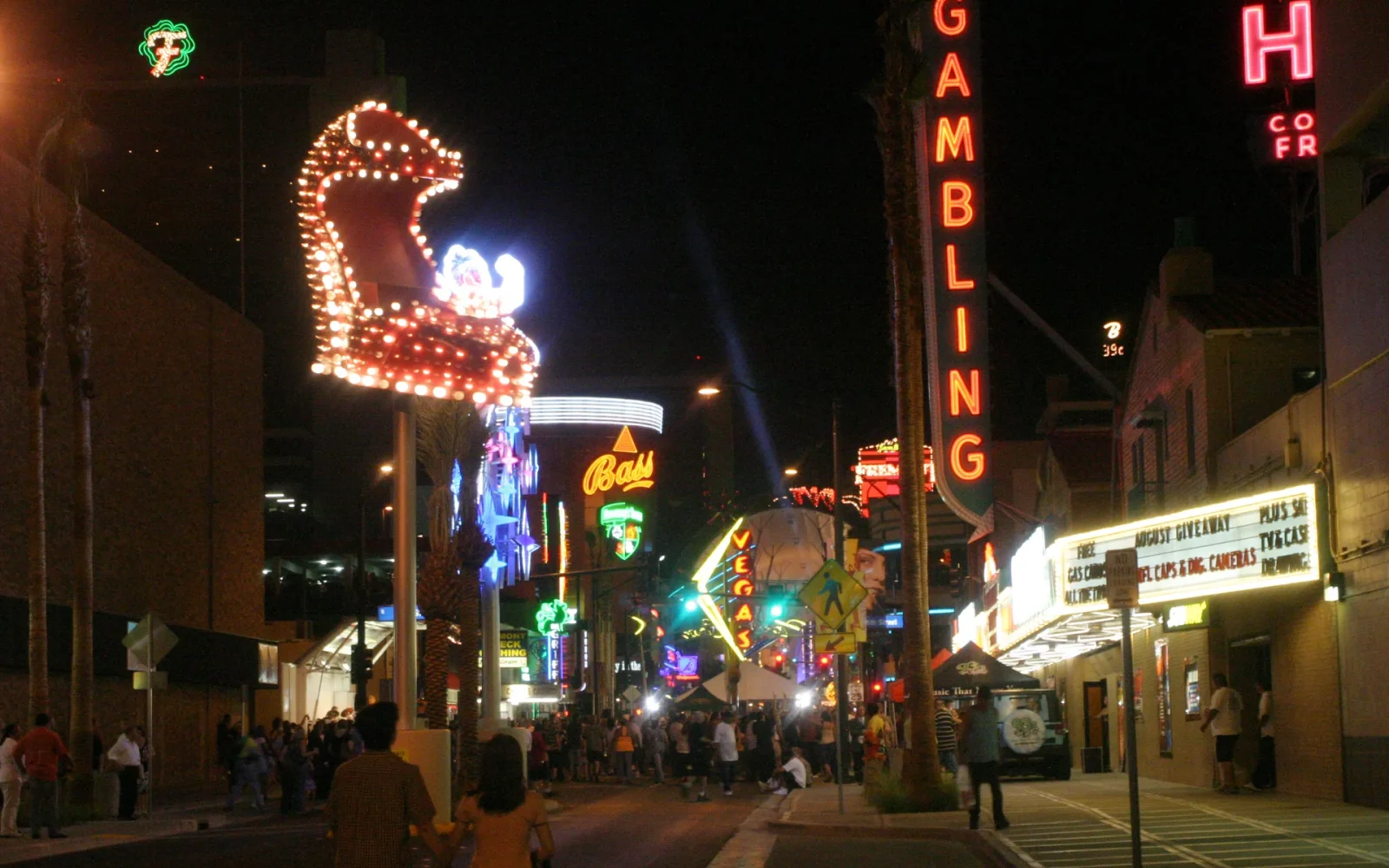
Las Vegas is famous after dark, but darkness is not its only revealing condition. The city changes sharply between blue hour, late night, early morning, and hard midday. Signs gain and lose visual authority. Mountains appear, disappear, and return at the edge of the basin. Service corridors wake up, dining rooms reset, galleries open, and outdoor plans become more or less practical. Experiencing those changeovers gives a short trip structure without turning it into a race.
Use evening for scale, not just brightness
At night, the resort corridor and Downtown are designed to compete for attention. Large facades, video surfaces, marquees, landscape lighting, music, and crowds produce an environment that is difficult to absorb all at once. Choose one area and one primary purpose for an evening. A performance, a meal, an architectural walk, and an observation point may all be worthwhile, but stacking them tightly can make the night feel like transit between reservations.
Look beyond color to understand the composition. Notice how entrances pull people from the sidewalk, how signs address drivers and pedestrians differently, and how interior routes filter visitors through a property. The spectacular surface is also a navigation system. When it works, scale and sequence make an enormous complex feel temporarily legible.
Plan around the event you cannot move
Show times, venue rules, ticket terms, and entry procedures can change, so confirm them with the venue or authorized seller. Use that fixed commitment as the center of the evening and give it realistic travel and entry time. The distance from a property entrance to a theater can be substantial even when the map pin looks close.
- Keep ticket and identification requirements accessible without displaying personal details in public.
- Choose a meal close enough that traffic or a long interior route will not control the experience.
- Set a clear meeting point because noise and crowds can make phone coordination difficult.
- Decide on return transportation before the group is tired.
Let late night become more focused
After a major event, the city can still feel fully active, but energy varies block by block and venue by venue. A late meal, a single lounge, or a measured walk may be more satisfying than trying to extend every night indefinitely. Follow current local guidance, remain aware of surroundings, and avoid isolated shortcuts through service areas or large parking structures.
Late night can also reveal the labor of changeover. Crews clean, restock, adjust lighting, prepare stages, and reset rooms for another cycle. Observe that work without obstructing it or turning workers into scenery. The polish visitors see depends on people performing precise tasks, often while the public environment remains open around them.
Use morning to find proportion
Morning brings the valley back into view. From an appropriate public vantage, the Spring Mountains and other basin edges explain the city’s geography more clearly than they can at night. Low light can also reveal texture in concrete, painted masonry, sign cabinets, and desert planting that electric color overpowers later.
This is a useful time for a neighborhood breakfast, a quiet architectural walk, a museum plan, or an outdoor excursion suited to the weather and the group. It is not automatically cool or empty. Check conditions, carry water, and assume that popular places may still require advance planning. If the previous night ran late, protecting rest may be the better choice.
Treat midday as a distinct visual state
Strong sun is often described only as something to avoid, but it gives Las Vegas a characteristic clarity. Shadows become hard-edged, pale concrete becomes luminous, and red sandstone flattens into bold fields of color. The effect can be striking in Downtown facades, Hoover Dam’s massive surfaces, Springs Preserve’s landscape interpretation, and Red Rock’s layered formations.
Practical limits come first. Outdoor exposure, walking distance, elevation, wind, and shade vary widely. Use official sources for current weather, access, and safety information. Shift to indoor cultural sites, dining, or rest when conditions make an outdoor plan unsuitable. A flexible itinerary is not a compromise in a desert city; it is competent planning.
Still comparing Sightseeing?
Ask for tour ideas, hotel suggestions, or a simple trip plan that combines both.
Trip Helper
Build contrast into each day
The strongest Las Vegas days often pair experiences that change scale and tempo. Follow a large production with a small neighborhood meal. Balance a dense sign environment with an open desert view. Place an exhibition or historic site between louder attractions. Move from a carefully controlled interior to a street where weather, traffic, and ordinary commerce are visible.
This contrast helps avoid two familiar mistakes. The first is treating the city as a sealed entertainment machine with no geography or daily life. The second is dismissing the spectacle in search of a supposedly more real Las Vegas. Both views leave too much out. The resort corridor, Downtown, creative districts, residential valley, and surrounding public lands are connected by workers, roads, water, power, and shared time.
Photograph transitions rather than stereotypes
For a more truthful visual record, photograph a place as it changes. A sign cabinet in daylight and illuminated later tells a fuller story than a permanent neon close-up. A wide city view that includes the basin gives context to street-level detail. A quiet table after a meal can sit beside the scale of a theater lobby without requiring anonymous crowd imagery.
Ask permission before photographing identifiable people closely, especially workers and performers. Respect restrictions around shows, museums, private properties, and artworks. Avoid blocking circulation for a picture. Las Vegas already supplies strong geometry, light, and material; it does not need staged gambling props or borrowed nostalgia to look specific.
Leave space for the city to change
Venues change, signs move, and neighborhoods develop. Verify operational details near the visit, but build the trip around durable interests such as performance, food, design, history, landscape, and community.
See the spectacle when the lights carry the city outward. Find the city when daylight reveals its basin, surfaces, and working rhythms. Together they explain why Las Vegas can feel dramatically different from one hour and one block to the next.